One artist frame only: TPE1 = tengri137. No comment, lyrics, cover art, private frame, or ID3v1 trailer is present.
FORENSIC RESEARCH ARCHIVE
Audio and onion route
The authenticated MP3, corrected audio-stage reconstruction, bitmap-derived key, and remaining gaps.
BINARY AND SIGNATURE AUDIT · 26 JULY 2026
The preserved MP3 is authentic and complete
The Downloads copy, repository copy, and historically verified original are byte-identical: 7,864,927 bytes, SHA-256 b424c155221cd62a5af23d33d68105dac72e0c41311d9ea57cc2901bc63134d7. A fresh isolated-keyring verification returns a good RSA signature from fingerprint 2A2C0AD4ED1CAD8353A30056D152D6C5666AB731, signed 5 March 2017 at 23:33:21 UTC. The clearsigned note verifies under the same key and predates it by 33 minutes.
Independent container audit
44.1 kHz joint stereo, Xing table, LAME 3.99r, 9,767 audio frames, gapless playback duration 255.111837 seconds after encoder delay and end padding.
The Xing byte count equals every byte after the 30-byte ID3 tag, and a full frame scan ends exactly at EOF. The terminal AA run is inside the final MPEG frame, not an extra payload.
Stage 1: what the MP3 spectrogram actually says
The MP3 spectrogram contains one payload: a three-line private Instaudio URL, instaud.io/private/7fa2c325c0a7395c8856c5bb4f11b5616c6f60c5. It does not contain the later-emended “LITTLE BIRD” wording. That sentence belongs to the next WAV stage.
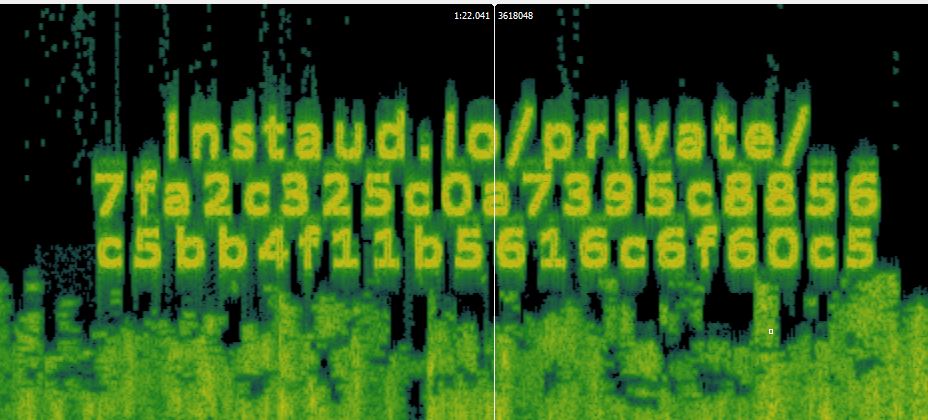
133d2ea16931244c2036ac6df764605f0a0a3a5c177069ff53550717881c1c41.Stage 2: the lost WAV and its recovered transcript
The Instaudio URL hosted 666ab731.wav, a 113.152-second file of timed packets. The blob is lost, but a contemporary March 2017 solver discussion preserves the reported route and duration transcript: lengths of 16, 32, 48 … 144 ms mapped to digits 0–8. It is corroborating solver evidence, not a replacement for the missing audio bytes. Tokenizing the preserved transcript on zero-runs gives a raw substitution assignment beginning LITTLE MIND KNOWS WHEN THE GATE IS OPEN, repeated three times. That assignment has a repeated N under two different token symbols. A contemporary solver's “BIRD” emendation restores an injective substitution and fits the Twitter/bird context, but other injective words are not excluded from the token pattern alone. The following A/x block, with A = 0 and x = 1, packs to ASCII 666666m7x6x5regc.onion.
Stage 3: onion, bitmap, message, endpoints
The Tor v2 service yielded the 23-by-137 Arecibo-like bitmap and signed themessage.txt. Reading 0 as one one-bit and non-zero digits as that many zero-bits reconstructs the bitmap exactly. Its 4-by-4 block decrypts every one of the 6,448 letters; the ending VISITBITLYAABBBCCCC resolves to signed knowledge.txt. A later signed notice closes that time-limited first path and opens the surviving rendezvous route.
What the “666ab731.wav” download actually is
The currently downloaded 4,210-byte file is not a damaged WAV: its first bytes are <!DOCTYPE html>, and it is an Instaudio front-page HTML response saved under a .wav filename. It has no RIFF/WAVE header or audio payload, so a spectrogram or codec repair would be meaningless. A retained 2017 page identifies the separate historical object, advertises it as a 1:53.152 / 1.73 MB WAV, and exposes its original S3 address. That object now returns HTTP 404 and no Wayback WAV capture is available.
The original recording is still unrecovered. Renaming the current HTML response cannot restore bytes that are absent.
This player renders the published 2,994 packet durations as a synthetic 1 kHz timing signal. The packet durations are source-derived; tone, one-millisecond boundaries, and fades are analyst-added. It is deliberately not labelled as the original WAV.
Historical page preserved by Wayback Machine. The reconstruction is a listening aid only.
What remains
The original WAV bytes are lost, so the duration-packet transcription cannot be regenerated from source audio. The bitmap's two added figures remain interpretive, and the rssstuvwx transcript tail is unmapped. No additional hidden tag or appended data was found in the preserved MP3.

2017 BEEP WAV · PRESERVED TRANSCRIPT, NOT RECOVERED AUDIO
The residual tail has a measurable limit
The contemporary 60-line duration transcript is internally complete: 2,994 base-9 digits split into 710 packets, and every packet maps through the published 27-token table. It reproduces three identical blocks, the 176-bit A/x onion decode, and END END END. The source WAV itself is still absent: a 27 July 2026 Wayback CDX query returned no archived capture for the exact S3 object or its object prefix.
The post-sentence run rssstuvwx has no source-selected codebook. Crucially, r through x are transcription labels assigned in first-occurrence order, not author characters: their raw duration runs are 1141, 1212, 1212, 1212, 12, 15, 2121, 8, 141. A Caesar or ASCII reading of those labels would decode the analyst’s notation, not a supplied alphabet. With the semantically apt but non-unique BIRD correction and a global injective substitution assumed, seven token symbols remain unmapped and admit 604,800 completions. This is a bounded ambiguity, not a license to choose a word.
2017 NUCLEAR-NUMBER CLUE · PRIMARY TEXT + SECONDARY INTERPRETATION
What the numbers do—and do not—give
The signed FAJNLpLZ note literally prints only 2, 8, 20, 28, 50, 82, .... They render as He O Ca Ni Sn Pb; that is useful contextual structure, but no source says to concatenate it as a password. The later 126 comes from a community observation about the onion prefix, not from the printed line. A compact audit records those boundaries and the immediate matrix-index controls.
PAGE 23 · HISTORICAL NEUTRON-REMAP HYPOTHESIS
The strongest nuclear-number decoding proposal fails structurally
A March 2017 solver proposed converting every Page-23 atomic number into a neutron count, then mapping it back through the periodic table. The full retained execution tests three isotope rules, orientations, and five row-9 variants. In every case, 33 / 154 cells map beyond element 118 and no complete row survives; uranium alone accounts for 18 failures because U-238 has 146 neutrons. A modulo-26 fallback produces 60 strings, all at the 0th percentile of the Turkish-language control. This closes that specific mechanism, not every possible role for the magic numbers.
Read the bounded negative audit → · Machine-readable record →
PUBLIC RECOVERY CHECK · 27 JULY 2026
The original WAV is not in the checked public archives
The live source-led S3 address now returns XML NoSuchBucket, not audio. A bounded recovery audit then checked the exact object/player family in Wayback CDX, every Common Crawl collection from 2017-13 through 2018-51, and Arquivo.pt. None returned a byte-bearing capture. This is evidence that the public recovery route failed; it does not prove that an offline download, private browser cache, unindexed mirror, or future discovery cannot exist.
Read the public-recovery audit → · Machine-readable result →