Page rasters match the author-signed tarballs pixel for pixel.
THE THREE-MINUTE BRIEF
What happened, what was solved, and what remains
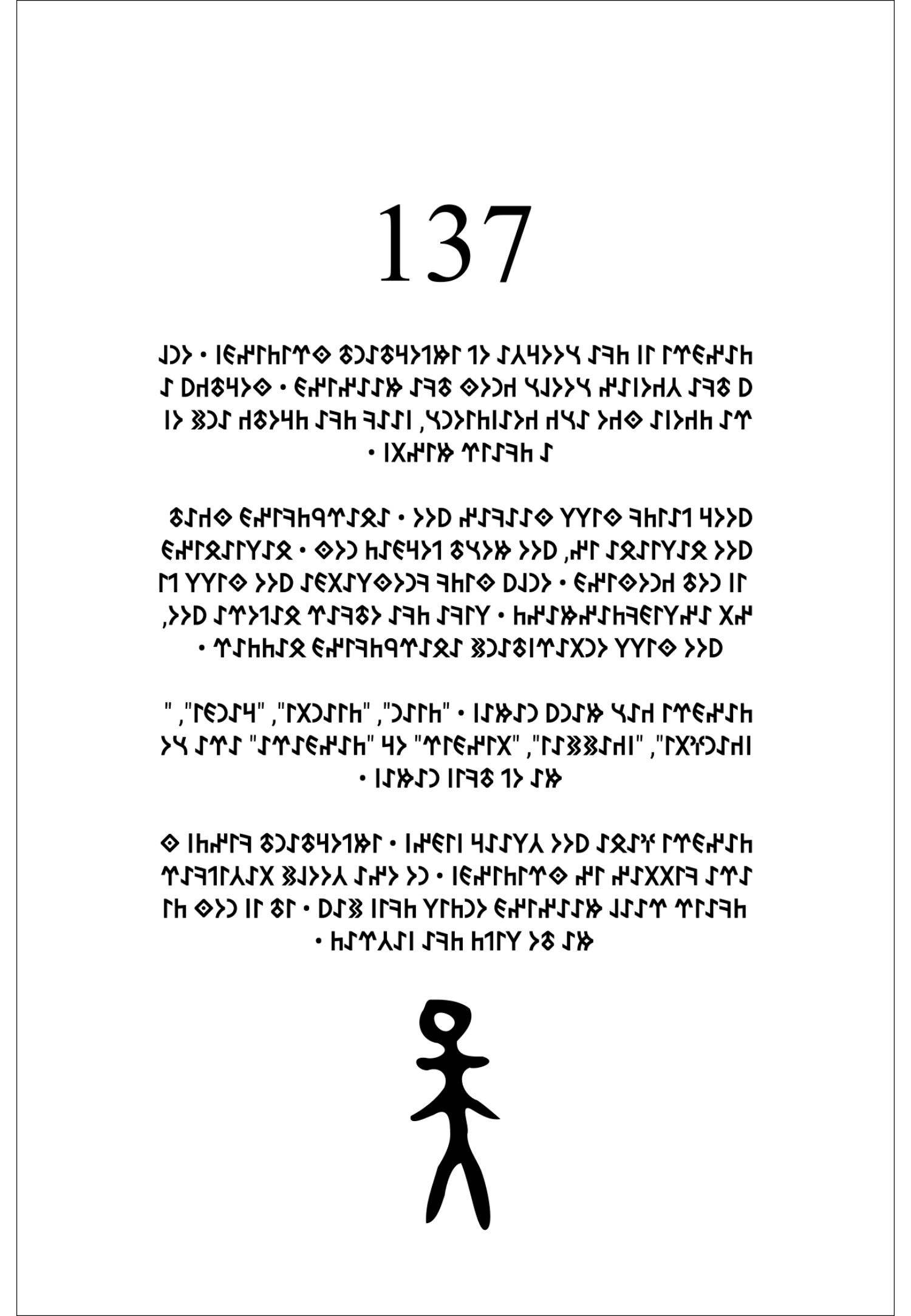
Tengri 137 was a technically competent anonymous puzzle published through a PGP identity in 2016–2017. It combined a 23-page cipher book, a timed audio trail, a retired Tor service, and a final signed ciphertext.
SOLVED Pages 1–22: substitution, mathematical constructions, repeating decimals, atomic numbers, and element initials.
STRONG RESULT Page 23: a deliberately planted Turkish graffiti rhyme appears in the row beginnings; its role as final answer or decoy is not signed.
SOLVED The 6,448-letter onion ciphertext: a 4 × 4 Hill cipher keyed by a number block inside the accompanying Arecibo-style bitmap.
PROVEN The bitmap encoding and the deliberate symmetry classes of its two author-added pictograms.
TWO PATHS The first signed endpoint was time-limited; its signed replacement points to Monday, 7 December 2037, 01:37:05 UTC.
DECODED Eleven Turkish number labels, all 2,816 kolam crossing bits, and a 352-character English warning; its authorial purpose and any 2037 action remain open.
This dossier reports the puzzle’s claims as part of its narrative, not as established science or history. The cryptography is real; the alleged extra-dimensional species, genetic selection, new physics, and Eternal Library remain story-world assertions.
PROLOGUE · 14 MARCH
The case begins inside a timestamp
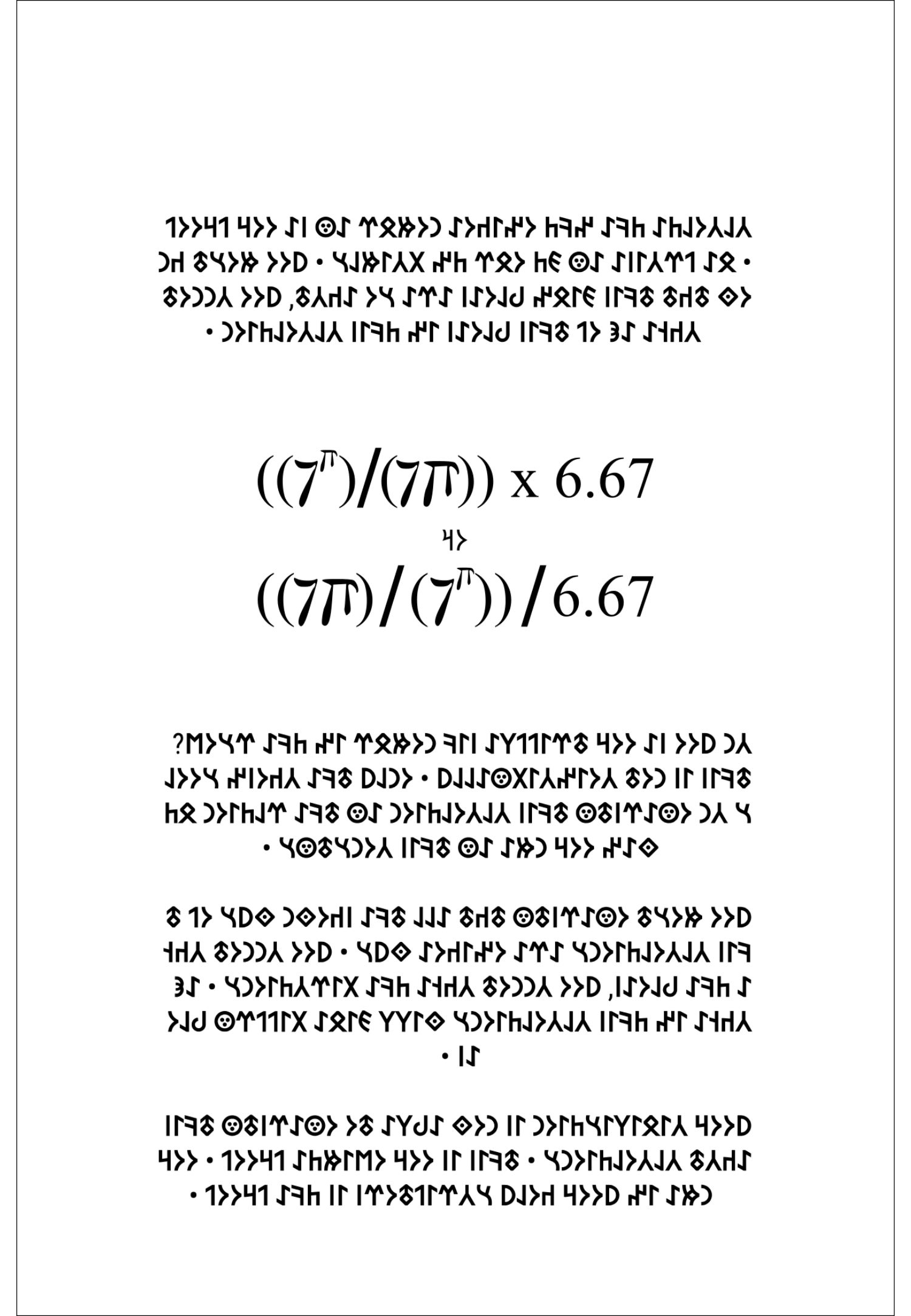
Before a solver reads a rune, performs a division, or opens an audio spectrogram, Tengri 137 has already hidden a message in the clock.
Twenty-three stark pages began circulating in 2016 under the name Tengri 137 and the account @666ab731. They mixed Old Turkic-looking signs, biblical quotations, magic squares, chemical elements, DNA imagery, the number 666, and a repeated promise: one “chosen soul” would receive access to an Eternal Library. The work presented itself as revelation. Its construction, however, behaved like an engineered puzzle.
All 23 page images inside the author’s two signed archives carry the same Unix modification time: 1331734166. Converted to local time, it is 2012-03-14 15:09:26—Pi Day, at the familiar digits of π: 3.14, 15:09:26. The first known tweet arrived on Pi Day 2016 at 15:09 local time. The page-23 matrix returned on Pi Day 2017. When the hidden service eventually opened, both files listed there carried a Pi-Day timestamp too.
Source note: book archives, timestamps, and page hashes.
The identical archive timestamp is cryptographically enclosed metadata.
The PGP identity anchors the authentic publication trail.
Investigator’s note. This is the cleanest example of the project’s motto, “Nothing is random.” It proves deliberate construction, not the supernatural claims embedded in the prose.
CHAPTER I · THE TWENTY-THREE PAGES
A book written in three different puzzle languages
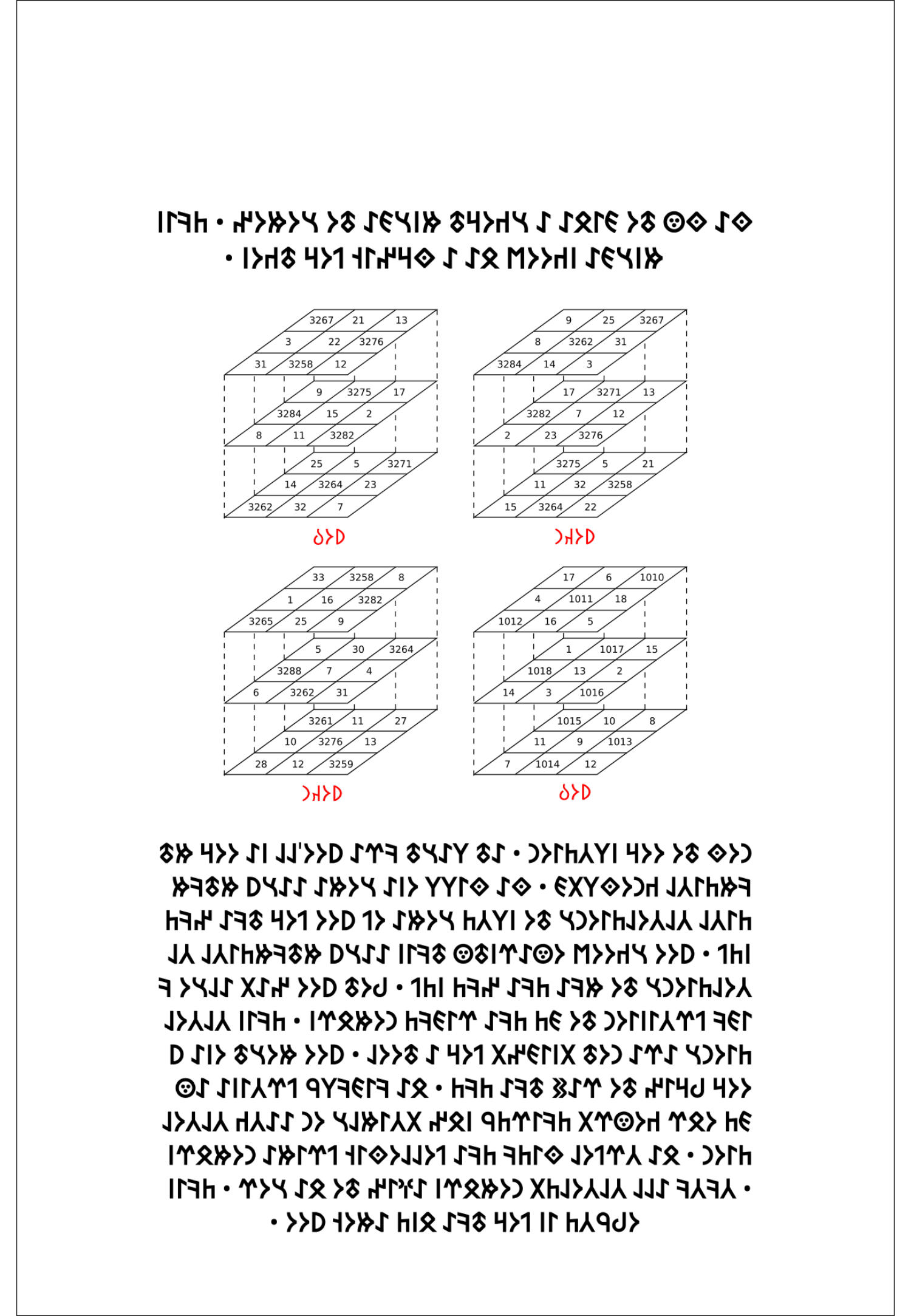
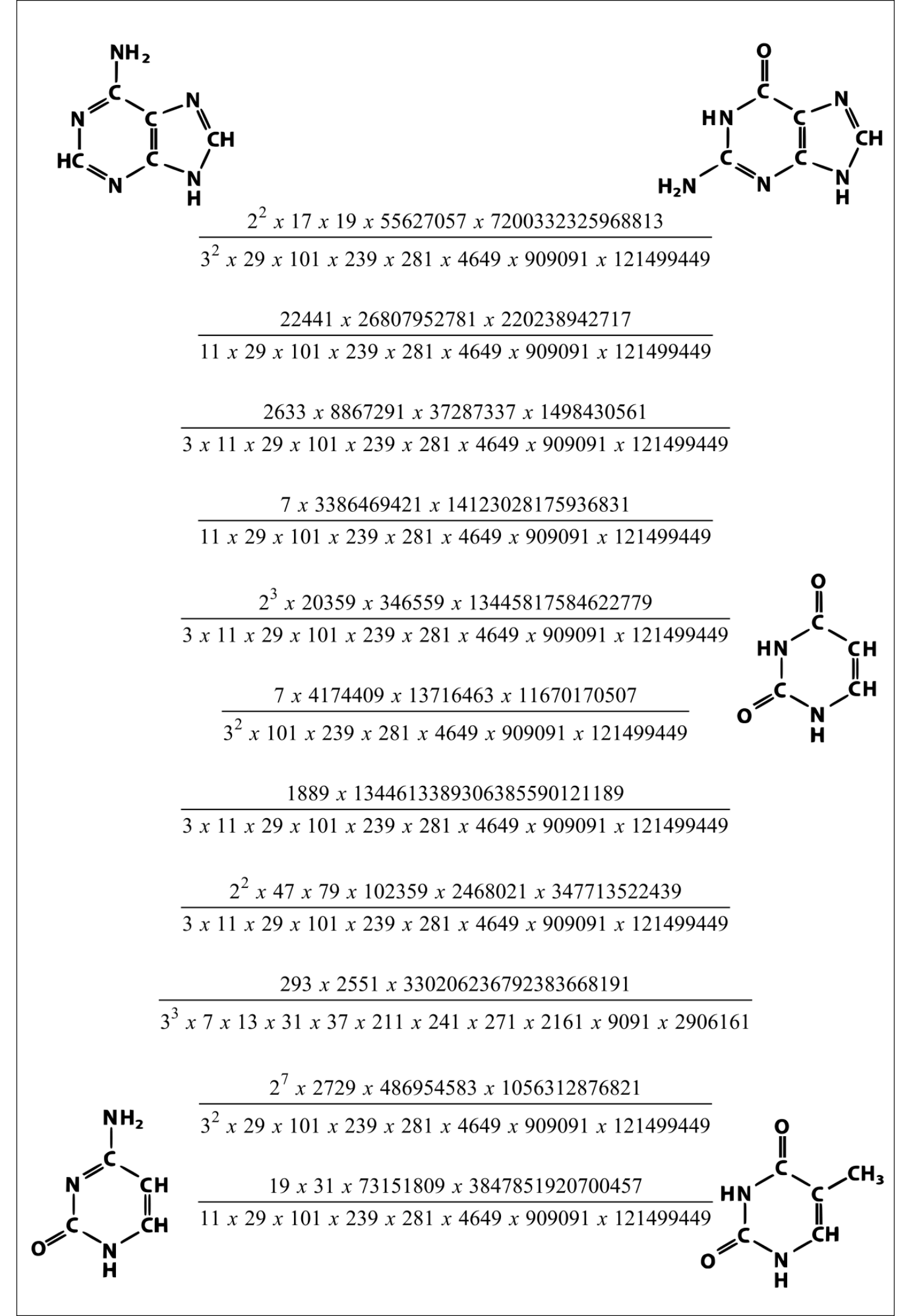
The book is not one cipher repeated twenty-three times. It changes method as the reader advances, turning the act of solving into a staged initiation.
Learn the alphabet
An Orkhon-inspired substitution yields English prose about Tengri, knowledge, selection, and a hidden library. The ancient-looking script is a mask over a modern English voice.
Learn the obsession
Magic cubes, rings, circles, and square constructions repeatedly resolve to 666. Biblical references are selected through adjacent numbers. Mathematical craft supplies the authority that the narrative claims for itself.
Learn the mythology of 137
Fine-structure-constant approximations, π, φ, the speed of light, chromosome symbolism, Cicada 3301 allusions, and biblical lifespans are braided into a private cosmology.
Learn the machine
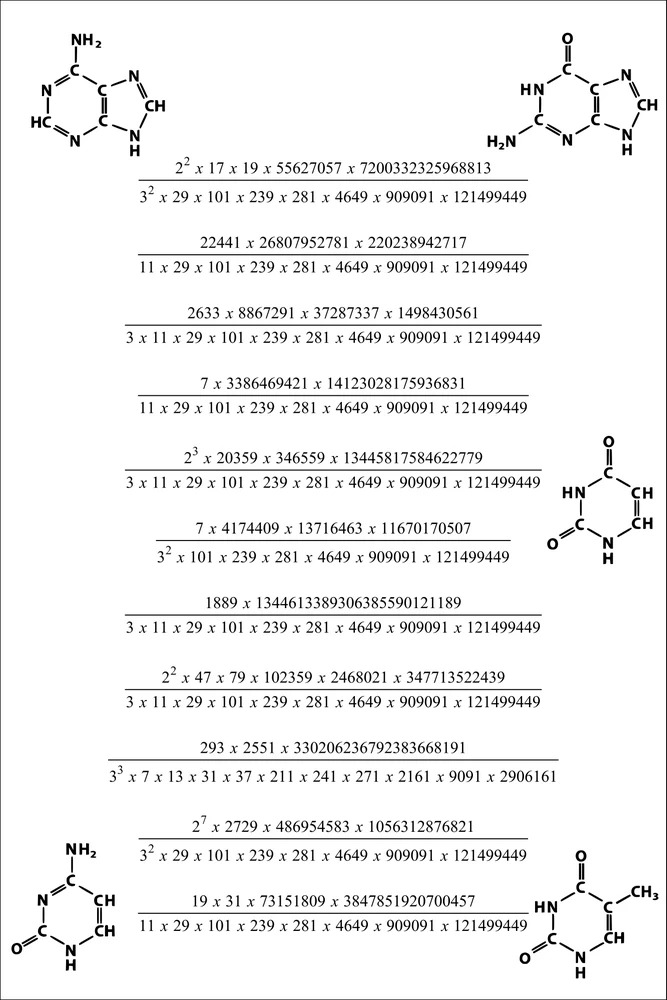
Fractions become repeating decimals; decimal groups become atomic numbers; chemical symbols become letters. The recovered manifesto announces aliens, finite cosmology, genetic encryption, and the Eternal Library.
Now forget what you learned
Eleven fractions and five nucleobase diagrams produce 154 pronounceable but opaque letters. The book ends exactly where its prior method stops being sufficient.
“UPCOMING TEXTS ARE GENETICALLY ENCRYPTED … WHO HAS THE CORRECT GENETIC CODING WILL UNDERSTAND THIS TEXT. ALL OTHERS WILL FAIL.”
The claim is part instruction, part intimidation. It encourages a solver to interpret every later failure as evidence that the puzzle is more advanced, rather than evidence that a proposed method is wrong. That rhetorical mechanism becomes important when evaluating the years of biological speculation that followed.
What the solved pages actually say
The first sixteen pages build the project’s voice. They treat Tengri as an ancient source of writing and knowledge, contrast knowledge with faith, invoke many names for a sky god, and promise a destination reserved for one person. Their Old Turkic-looking signs are a substitution device, not evidence of an ancient language hidden in the book.
Pages 17–22 turn that voice into a manifesto. The recovered text declares a finite universe, calls human gods dangerous, denies God’s existence, describes civilisation as subject to a critical evolutionary limit, and promises an Eternal Library to a chosen reader. It then announces the “genetically encrypted” stage. The cipher authenticates that this is the author’s message; it does not authenticate the cosmology, biology, or promise.
The numerical theatre has a similarly concrete inventory. Four cubes point to Revelation 13:18, Ezra 2:13, 2 Chronicles 9:13, and 1 Kings 10:14; each is built around 666. Later pages turn circles, squares, Odin’s triple horn, the fine-structure constant, pi, phi, light speed, and Biblical lifespans into one private system. Page 16 explicitly folds Cicada 3301 into the performance through cubes summing to 3301, 3299, and 1033. These are designed constructions and references—not independently discovered physical laws.
Textual care. The preserved readings include a page-19 arithmetic/typesetting fault and a small number of word-spacing or letter-level variants in community copies. This dossier reports them as variants rather than silently smoothing them into a cleaner manifesto.
Source notes: pages 1–16 verification · pages 17–22 verification.
CHAPTER II · THE PUBLIC BREAKTHROUGH
The fractions give up their secret
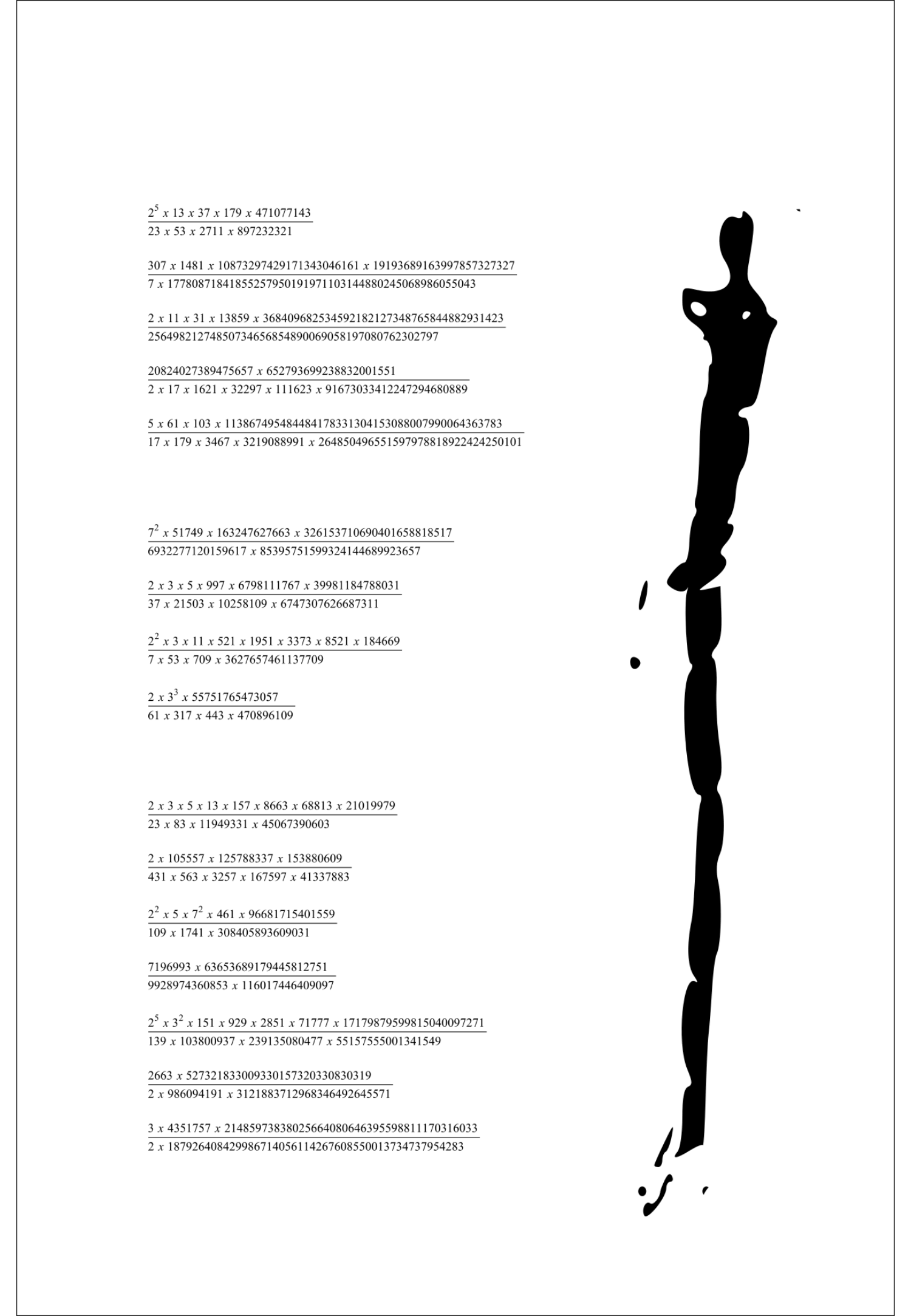
The decisive 2017 breakthrough came from reader Klaus Tappeiner, with one line credited to Norbert Biermann and the work published through Klaus Schmeh’s cryptography column. The method was mechanical enough to reproduce and strange enough to fit the book’s chemical imagery.
Printed fraction→Repeating decimal→2/3-digit atomic numbers→Element symbols→Initial letters
The opening decimal sequence 43 77 25 63 87 76 37 22 80 63 43 37 92 22 72 maps to Tc Ir Mn Eu Fr Os Rb Ti Hg Eu Tc Rb U Ti Hf. Taking the first letter of each symbol yields TIME FOR THE TRUTH. The method unlocks pages 17–22 and can be independently recomputed from the printed arithmetic.
The resulting prose is not a neutral reward. It is a manifesto in the voice of designers of civilisation: they deny being gods, deny God’s existence, describe the universe as finite, warn that humanity has reached a critical limit, and promise access to knowledge for a biologically selected reader. Cipher validity authenticates the recovered text; it does not authenticate its claims.
Known textual fault. One fraction on page 19 contains a print error. The literal typesetting produces gibberish; the community working form moves a leading digit into the numerator and restores the intended line. The error is preserved instead of silently corrected.
CHAPTER III · PAGE 23
The rectangle that looked like an incantation
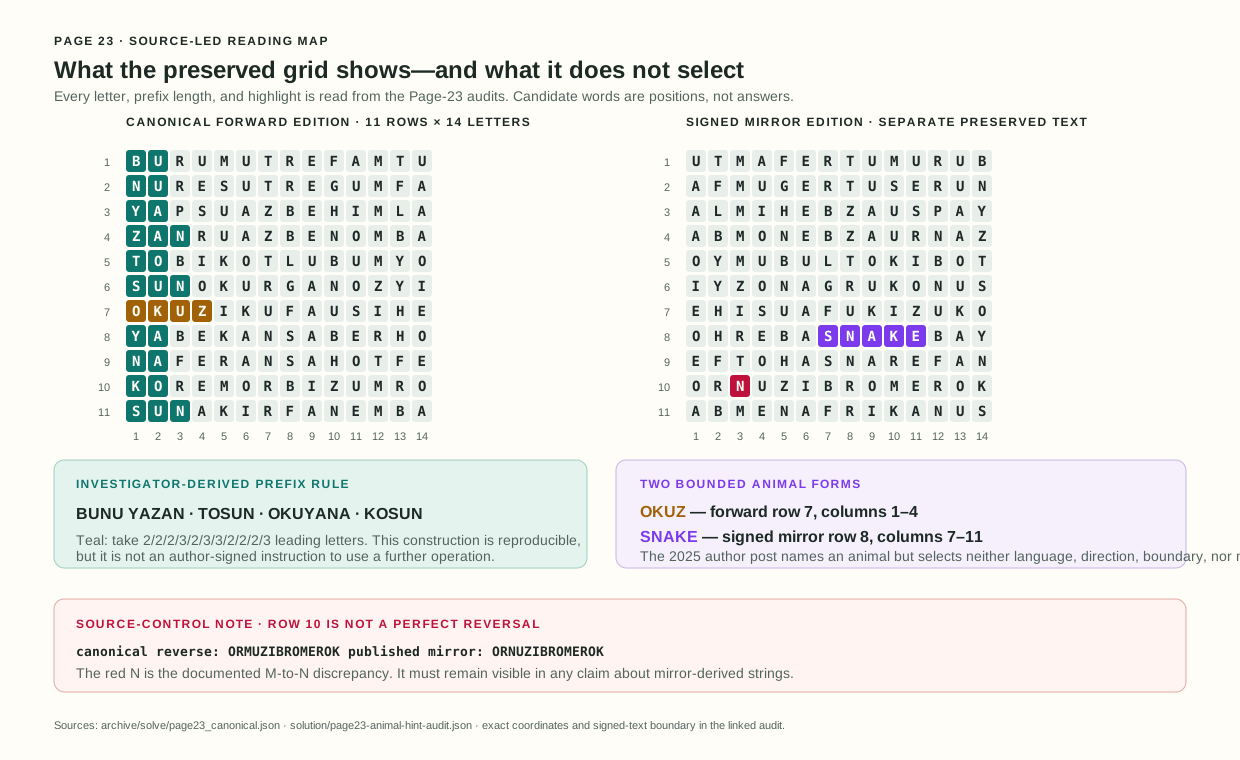
The same fraction method converts page 23 into eleven rows of fourteen letters. Ten rows are arithmetically pinned; row 9 admits five legal segmentations because its period has 30 digits rather than 28. The author later published the preferred matrix under a valid PGP signature, then published its horizontal mirror under the heading NOTHING IS RANDOM.
BURUMUTREFAMTU
NURESUTREGUMFA
YAPSUAZBEHIMLA
ZANRUAZBENOMBA
TOBIKOTLUBUMYO
SUNOKURGANOZYI
OKUZIKUFAUSIHE
YABEKANSABERHO
NAFERANSAHOTFE
KOREMORBIZUMRO
SUNAKIRFANEMBA
The two signed editions contain one disagreement. Arithmetic forces M at forward row 10, column 12; the author’s hand-mirrored publication prints N at the corresponding position. The signature proves who published the error, not that the error is correct.
What the author did—and did not—settle
Pages 21 and 22 announce a new stage and tell the reader to proceed through it, but they do not supply a genetic code table. The author subsequently signed both matrix orientations: the forward “first sequence” and a horizontal mirror headed NOTHING IS RANDOM. Neither signed statement declares one orientation correct, explains the nucleobase drawings, or names a final key.
That omission matters. On 2 May 2021, a now-recovered @666ab731 post published a BitClout/DeSo public key; the linked public profile calls itself 666ab731, points back to the account, and later that morning says, “Page 23 is not solved since 2016.” Its attached image redraws the original eleven fractions and five nucleobases, but supplies no marked base, key, traversal, or new plaintext. This is strong publication context, not a PGP identity bridge. The Turkish extraction below is therefore a serious investigator-derived result, not a signed author confirmation.
The Turkish plaintext hiding in the row beginnings
Take prefixes of length 2 2 2 3 2 3 3 2 2 2 3: BU · NU · YA · ZAN · TO · SUN · OKU · YA · NA · KO · SUN. They produce BUNU YAZAN TOSUN, OKUYANA KOSUN, an attested Turkish toilet rhyme. The same extraction survives the independently signed mirror edition. Among all 2,048 possible two/three-letter prefix assignments, it ranked first under the retained dictionary-aware model and was the only exact five-word result.
TOSUN means a young bull or steer and directly fits the account’s 2025 hint that Page 23 contains an animal name “but not the fox.” Row 7 also begins OKUZ—Turkish öküz, “ox”—which supports deliberate bovine construction. The semantic payload is therefore solved with high confidence; what remains unsigned is whether it is every layer or the final reward.
The 154 letters, their derivation, both signed editions, the one M/N error, the restricted 19-letter alphabet, and the structural prefix reading.
That the Turkish rhyme is every intended layer or the final reward, rather than a solved message inside a larger system.
Years of amino-acid, codon, selenoprotein, classical cipher, transposition, binary, and language attacks have not produced an independently reproducible second plaintext. The page looks biological because it contains nucleobases and follows a “genetically encrypted” warning. That is motivation to test a model, not evidence that every biological model is valid.
Source note: Page-23 canonical data, model, controls, and limits.
CHAPTER IV · WHAT THE MATRIX SURVIVED
Tests that made the mystery smaller
The 154 letters have attracted a decade of attractive theories. The record is more useful when it preserves the failures as carefully as the successes. These are not arguments from disbelief: each is a bounded test against a stated input and result.
The five bases
Pixel-level inspection found conventional textbook drawings of adenine, guanine, uracil, cytosine, and thymine: no altered bond, atom, orientation, or mark that can function as a hidden index. Hydrogen-bond and layout permutations did not recover a better reading.
Biology is not a decode
Amino-acid and selenoprotein readings fail basic composition checks: the matrix overuses ambiguity and rare residue symbols while omitting ordinary ones. A “hidden codon table” is a community proposal, not an author-supplied artifact.
Magic numbers
The signed sequence 2, 8, 20, 28, 50, 82, ... identifies nuclear shell closures. In the proposed forward row-major, one-based reading, those six author-printed positions yield URUABZ. 126 is a later community continuation; only after adding it does the output become URUABZE. Neither indexing rule is source-selected, and the community-extended URUABZE failed as an MP3Stego password.
Not a hidden audio key
An exhaustive bitmap sweep confirms that the Arecibo-like image re-encodes matrix row 1 but cannot contain rows 2–11. Using the matrix as a key against themessage.txt also returned a calibrated negative.
Classical attacks
Route, columnar, Vigenère, Beaufort, affine, and sampled Hill approaches failed to improve on the original matrix. The apparent periodicity is explained by the 14-column grid, not a recovered keyword.
Numbers beneath the letters
The pre-image atomic-number grids, intermediate quotient blocks, neutron remap, and row/column readings were tested separately. None produced an independently repeatable plaintext or key. Negative results close a route; they do not prove that no undiscovered route exists.
The remaining dispute is now narrower. The Turkish row-initial sentence is the solved semantic payload. The corpus still lacks proof that the remaining 128 letters are pure filler or that the author intended no operation after the joke.
CHAPTER V · A SOUND FILE AND A HIDDEN PATH
The puzzle leaves the book
The forward matrix publication carried nuclear magic numbers—2, 8, 20, 28, 50, 82…—and a shortened link to a Dropbox folder. Inside were an MP3, its detached signature, and a signed sentence: “There is a hidden path in front of you. Find it and you will be rewarded.”
A fresh binary and OpenPGP audit fixes the provenance. The Downloads and repository copies are identical at 7,864,927 bytes (SHA-256 b424c155221cd62a5af23d33d68105dac72e0c41311d9ea57cc2901bc63134d7). Both the detached MP3 signature and the clearsigned note validate under fingerprint 2A2C0AD4ED1CAD8353A30056D152D6C5666AB731. The MP3 contains only one small ID3 artist field, a complete Xing/LAME stream, and no appended payload.
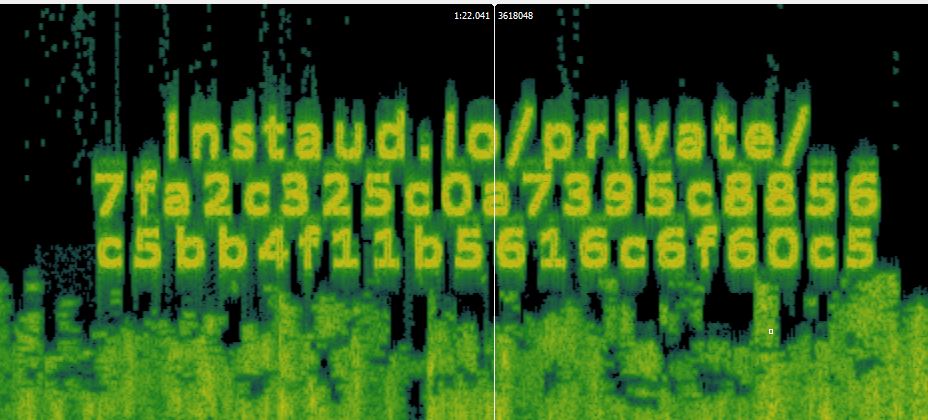
- The signed MP3255.111837 seconds of gapless playback, 44.1 kHz stereo. Its spectrogram contains a private Instaudio URL—nothing more.
- The lost WAVThe linked file consisted of variable-duration beep packets. The binary is now gone; only contemporary transcripts survive.
- The base-9 correctionPacket lengths encode digits 0–8 in 16 ms steps. Contemporary notes calling it “octal” preserve an abandoned first hypothesis.
- The readable warningThe raw 2,994-digit substitution assignment reads “LITTLE MIND KNOWS WHEN THE GATE IS OPEN.” A contemporary semantic emendation substitutes “BIRD,” which repairs a repeated-letter collision and fits the Twitter context, but the token pattern alone does not uniquely select that word. The stream ends with “END END END.”
- The addressA 176-character A/x block, read as A=0 and x=1, becomes 22 bytes:
666666m7x6x5regc.onion.
The chain is unusually well witnessed: contemporary Cipherbrain comments, Reddit discoveries, Wikia copies, surviving images, and signed files agree on its meaningful payload. It also illustrates why chronology matters. The page-23 matrix was derived from fractions; the second audio file did not generate it. Those threads became conflated in later retellings.
Earlier contact route, secondary source. A 2017 Reddit post records that tengri137 [at] sigaintevyh2rzvw.onion disappeared from the account profile during a Sigaint outage. The local Wayback Quickstart separately preserves the claimed workflow of mailing Fine-structure constant, 1515009125 to that address. Neither record authenticates a reply, endpoint, or the post author’s speculation about the outage. Original Reddit post ↗
Source note: audio and onion-route verification.
CHAPTER VI · THE GATE OPENS
Two files waited behind the onion address

On 2 April 2017, a signed message announced: “The gate is open now.” A surviving tor2web screenshot shows an Apache directory listing with exactly two listed files, both staged on Pi Day at 15:09.
PRIMARY · SIGNED BYTES
themessage.txt
6,448 uppercase lettersThe complete ciphertext is protected by a GOOD RSA-4096/SHA-256 signature. Its final instruction, VISITBITLYAABBBCCCC, reads as visit bit.ly/aabbbcccc and leads to the recovered ONION archive.
PRIMARY-DERIVED · UNSIGNED RECOVERY
nothingisrandom.txt
1,422 encoded digitsThe raw signed paste is lost, but two contemporary channels preserve the digit payload. Its run-length expansion yields exactly 3,151 bits.
The real 137-shaped image
For nothingisrandom.txt, read each zero as one black bit and each non-zero digit as that many white bits. The result is exactly 23 × 137 = 3,151 pixels and matches the contemporary community bitmap row for row. Its upper portion reproduces the 1974 Arecibo message; the added region carries Tengri-specific material, including a re-encoding of matrix row 1.
The false 47 × 137 grid
themessage.txt does not fit 47 × 137: that rectangle holds 6,439 characters, nine fewer than the authenticated ciphertext. No header, footer, or padding explains the difference. The grid appears nowhere in the contemporary record and is a later back-projection of the genuine 23 × 137 bitmap onto the wrong file.
The structure that actually exists
Repeated sequences in themessage.txt align overwhelmingly at offsets divisible by four. A 2026 reproducible pass recovered the 4×4 Hill decryption matrix directly from the nothingisrandom.txt bitmap and produced coherent English across all 6,448 letters with no discarded characters. Independent control keys did not approach its word coverage. The bitmap is therefore a key artifact, not merely an Arecibo-themed decoration.
What remains inside the bitmap
The first 1,679 bits of the 23 × 137 image reproduce the 1974 Arecibo message exactly. The author-added area contributes 64 further rows, including a re-encoding of Page-23 row 1, a 4 × 4 Hill key, and two deliberately symmetric pictograms. The digit-to-bit rule is now fixed; the figures’ intended referents and a few smaller number blocks remain open. The result is a bounded mystery, not a blank cheque to project every matrix row into the image.
Evidence hierarchy matters here. The ciphertext is one of the strongest artifacts in the case because every letter is signed. The accompanying nothingisrandom.txt prose is weaker because only a typographically altered web reproduction survives.
CHAPTER VII · THE MESSAGE INSIDE THE BITMAP
The key was hiding in plain sight
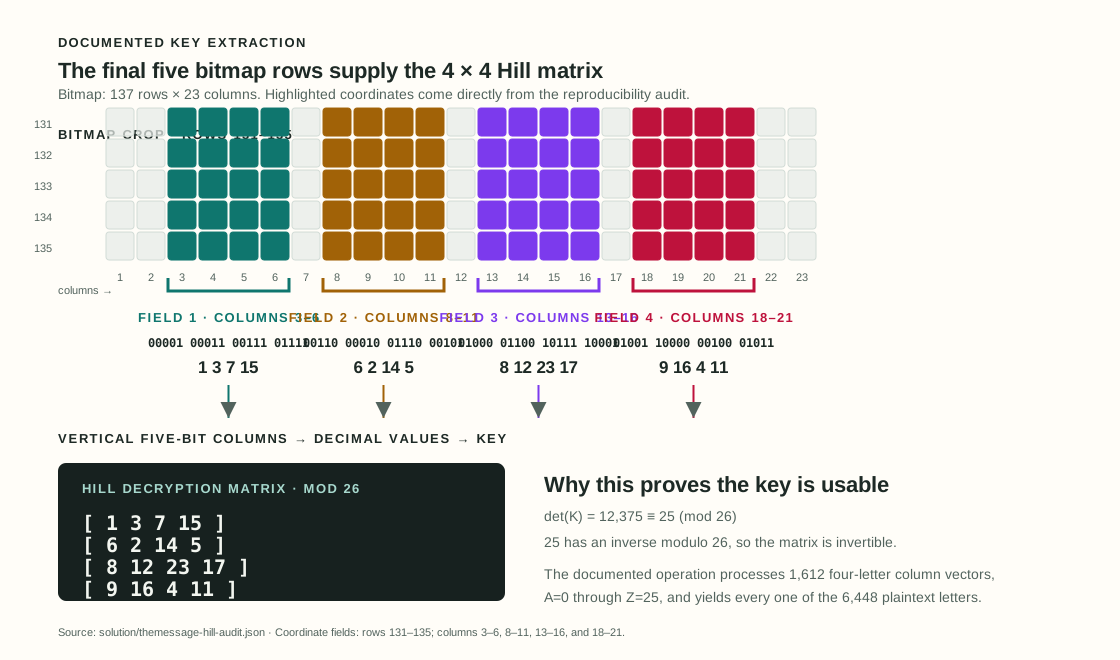
For years, nothingisrandom.txt was treated as an Arecibo homage with a few Tengri additions. The 2026 reproducibility pass established a more precise role. Its digit string deterministically expands into a 23 × 137 bitmap: every 0 emits one black/one-bit pixel, while every non-zero digit emits that many white/zero-bit pixels. The 867 literal zeros and the non-zero digits summing to 2,284 yield exactly 3,151 pixels.
Inside that bitmap is a 4 × 4 number block. Used directly as a Hill-cipher decryption matrix over the 26-letter alphabet, it decrypts the complete signed themessage.txt—all 6,448 letters, in 1,612 four-letter blocks, without discarded characters. Repeated ciphertext n-grams independently align on offsets divisible by four, and random invertible keys do not approach the resulting English word coverage.
The key artifact. The bitmap supplies the 4 × 4 decryption matrix [[1,3,7,15],[6,2,14,5],[8,12,23,17],[9,16,4,11]]. Its determinant is 25, so it is invertible modulo 26.
A manifesto about an alleged extra-dimensional species, human intermediaries, genetic selection, anti-religious claims, and a promise of further instructions. Decryption authenticates the message as text under the signed key; it does not validate its worldview.
The result also resolves a persistent endpoint puzzle. The terminal sequence VISITBITLYAABBBCCCC parses as visit bit.ly/aabbbcccc. That working link leads to a Dropbox archive containing an ONION folder and knowledge.txt: a PGP-signed Tengri 137 note saying, “The last step is coming. Visit this place again!” It was the first, time-sensitive ending. A later signed message says nobody found its hint in time, closes that opportunity, and opens a second path at bit.ly/rendezvous137.
Historical cross-check. A 2017 Reddit user proposed this same matrix but did not execute the decryption. The modern result was obtained from ciphertext structure and controls before that contemporary proposal was compared.
Source note: cipher report, controls, hashes, and plaintext.
CHAPTER VIII · THE AUTHOR-ADDED FIGURES
Two deliberate shapes, not two decoded sentences
The author-added part of the bitmap contains two formerly unexamined pictogram regions. Their construction is measurable. Rows 84–100 are perfectly mirror-symmetric, forming an hourglass or double-cone with a narrow waist. Rows 111–129 are perfectly invariant under a 180-degree rotation but not reflection: a chiral, two-fold rotational object built from opposed arcs.
A cap, widening body, and a monotone taper to a waist make a deliberate hourglass profile.
Its rotation-only symmetry makes it chiral; reflection is consistent with chance.
No comparable window in the original Arecibo message reaches perfect symmetry in either class.
That proves deliberate geometry, not a literal picture-name or a text payload. Atomic-number window tests produced values within a density-matched random null and are rejected. “Bridge/throat” and “helix” were testable investigator hypotheses suggested by the manifesto, not decoded labels.
That comparison has now been run against author-signed later figures and arbitrary hourglass controls. The bridge/helix reading does not survive the pre-registered multiple-comparison threshold and is rejected as a decode. The figures' exact symmetry remains proven; their referents remain unknown.
Source note: bitmap reconstruction, geometry, and control results.
CHAPTER IX · CLAIMS, CORRECTIONS, AND THE KEY
The signature is real. The legends are not automatically real.
The evidentiary spine is an OpenPGP identity: key 0xD152D6C5666AB731, fingerprint 2A2C0AD4ED1CAD8353A30056D152D6C5666AB731, published under the names “Tengri 137” and “Tengri (137).” Good signatures bind specific bytes—the two book archives, matrix editions, MP3 material, later images, and the 6,448-letter ciphertext—to that key. They do not verify an alien origin, a named human operator, or the truth of any claim inside a signed message.
Eternal Library
Confirmed as a phrase in the decoded book. No signed artifact identifies a reachable library, a downloadable reward, or a successful recipient.
KIWI and GARLIC
KIWI has no traceable Tengri-source origin. GARLIC was a community-facing vanity-onion tool, not a Tengri entity or a documented step in the puzzle.
Invented addresses
Several recurring onion and IPv6 claims belong to unrelated mystery communities or later retellings. They are absent from signed Tengri material. The historically documented address is 666666m7x6x5regc.onion.
The “correct orientation” myth
The reversed signed paste is real; an author declaration that it is “the correct version” is not. The preference for a direction comes from the acrostic and Orkhon context, not an explicit instruction.
Identity leads
Two recovered public-key certifiers—Noah Mercitalis and Varol Tepecik—cryptographically certified the older Tengri (137) UID in May 2017. Austrian and Turkish contextual clues, linked accounts, and shared documents can narrow a plausible milieu. None is an authenticated bridge from the PGP key to a legal identity.
Later AI analysis
The 2026 selenoprotein repository preserves useful source mirrors but its proposed solution includes self-falsification and wrong-cell patching. Its interpretation remains speculation, not a breakthrough.
The publication trail is part of the evidence
The key was created in April 2016. The corpus verifies 19 good clearsigned author messages and four detached signatures over binaries, including the two book archives, the MP3, both matrix editions, the 6,448-letter ciphertext, and the 2017 rendezvous image. Four third-party certifications sit on the older Tengri (137) UID. Two are publicly recoverable and verify to the public UIDs Noah Mercitalis and Varol Tepecik; two issuer keys remain unrecovered. These records show that key holders certified a pseudonym, not who operated it. A small set of BAD-looking copies are documented truncations whose signature armor was copied intact while their body was shortened—not rival evidence.
Twitter posts, Pastebin messages, Imgur, a fan-made signature verifier, and short links to several Dropbox folders formed the distribution network. The normalized account annex preserves 95 recovered tweet bodies, four known tombstones, all ten author-linked Pastebins, and fifteen attached Twitter images locally; three late public-syndication recoveries, two April-2017 replies recovered from saved direct responses and corroborated by historical screenshots, and one Wayback-restored 2021 BitClout pointer are separately marked outside the immutable original discovery index. The MathEasySolutions replies document a separate public contest exchange, not a new cipher key. A 27 July 2026 exact-ID sweep of the four named gaps found no body in the former syndication endpoint, Wayback CDX, the time-nearest Common Crawl index, or Arquivo.pt; that is a bounded archive result, not proof that the posts were empty. The live profile reported 132 posts, so gaps are stated rather than hidden. The fan verifier embeds the genuine public key but explicitly says it is unaffiliated. An unrelated Cicada-flavoured PGP key and several copied messages are positively excluded from the Tengri evidence set.
Open the complete recovered tweet archive →
The point is not to strip the case of atmosphere. It is to preserve where the atmosphere came from. A colourful claim becomes part of the story only after its source, date, and relation to the signed record are known.
Source note: PGP artifact audit.
CHAPTER X · THE ATTRIBUTION QUESTION
Ali Kutlusoy: a documented public lead, not an attribution
Public records create a specific lead involving Ali Kutlusoy, but they do not identify the operator of the Tengri 137 key. No Tengri 137 PGP message names him, and no public cryptographic proof binds his accounts to that key. The material therefore remains a circumstantial public lead, not an authorship finding. The dossier does not publish private contact details, local research paths, or claims about a private person beyond public records.
Public identity
A public GitHub profile under kutlusoy identifies its owner as Ali Kutlusoy, lists Austria, links an X account named @kutlusoy, and points to Elektron Net. This establishes what that public profile says about itself—not a connection to Tengri.
The 137 pattern
2018 reporting on the public XRPuzzler project names Ali Kutlusoy and describes a 137.036 XRP reward, explained through 137 and the inverse fine-structure constant. Tengri 137 uses the same number and the same physical constant as a central motif.
A later public project
The public Elektron Net repository describes a Bitcoin Core fork with a mandatory 137-day pruning rule. It is a striking thematic recurrence: 137 converted from cosmological symbolism into a protocol parameter.
Language and themes
Turkic material, puzzle construction, 137 numerology, speculative technology, and later political or cosmological writing create a coherent possible milieu. Similarity is circumstantial evidence; it cannot substitute for a signed link.
Three live explanations
Direct authorship. The same person designed Tengri 137 and later public projects. The repeated 137 fixation, puzzle practice, language context, and technical themes make this worth investigating.
Shared circle or influence. Tengri may have come from a collaborator, a community, or an earlier project whose motifs later reappeared around Kutlusoy’s public work.
Pattern overlap. 137, crypto puzzles, and speculative physics are visible internet motifs. A thematic match without a verifiable bridge can be coincidence or retrospective pattern-matching.
What would settle it
A conclusion needs an authenticated bridge: a Tengri-key signature referring to a public Kutlusoy-controlled account; a verifiable cross-signature; contemporaneous source material linking the identities; or an explicit, independently verifiable acknowledgement. Until then, “Ali Kutlusoy” belongs in the dossier as a named public lead with a circumstantial status, not in the verdict as established fact.
Source note: attribution status in the evidence ledger.
Public records: GitHub profile · Elektron Net repository · 2018 XRPuzzle coverage · contemporary Turkish coverage
CHAPTER XI · THE CROWD AROUND THE PUZZLE
The solution record was distributed across a disappearing web
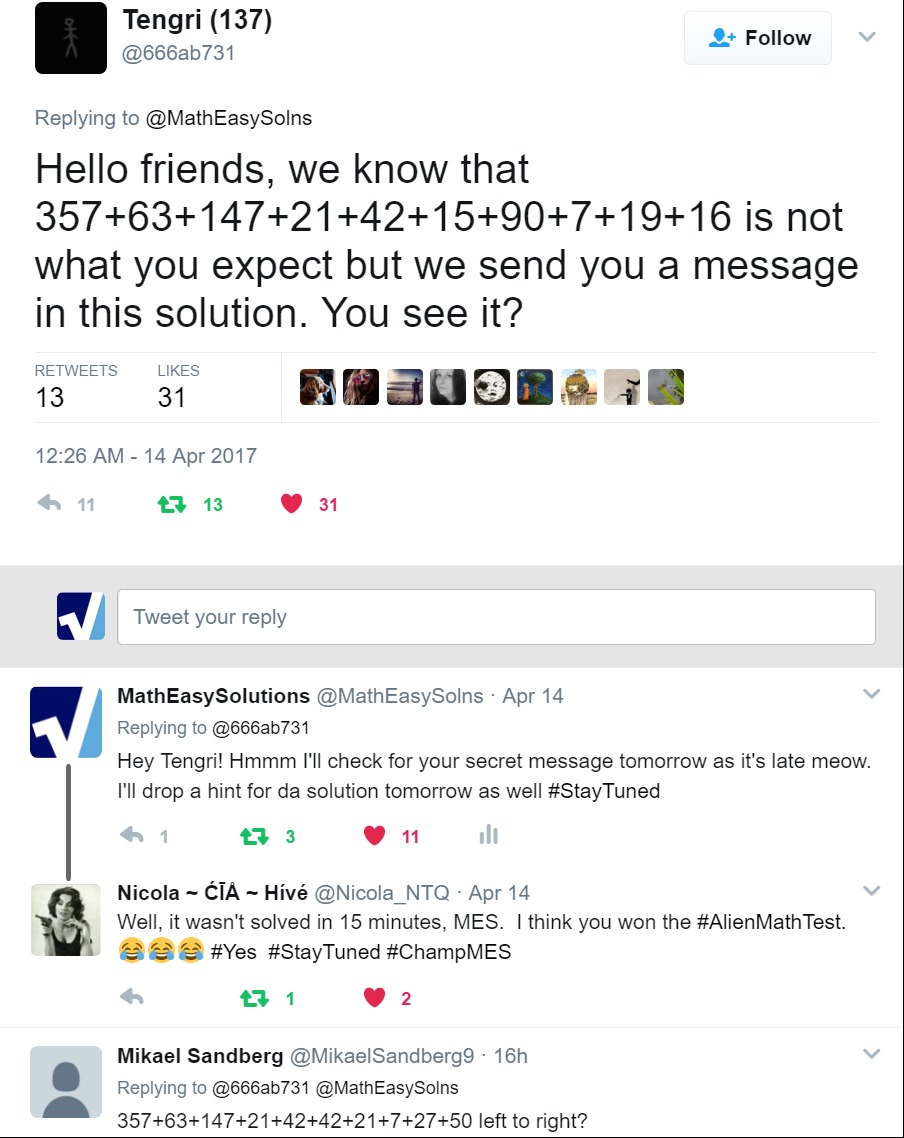
No single forum solved Tengri 137. Cipherbrain became the de-facto solver chat; Reddit recorded discoveries, dead links, and speculative attacks; a deleted Wikia preserved working translations; Pastebin held signed payloads; blogs and videos carried partial reconstructions; Turkish, German, Russian, and other non-English channels added context. Many original hosts later vanished.
The research corpus reconstructs this distributed record in three layers. A chronological harvest preserves discovery order. Channel-based recon separates Reddit, archives, cryptography, audio, code hosts, and non-English sources. Fourteen high-value artifact topics were then independently reconstructed twice from deliberately disjoint source sets, diffed character by character, merged, and adversarially verified.
Chronological first-pass capture.
Source-channel reconstruction.
Targeted recovery and falsification rounds.
Where the public record lives
Four Cipherbrain articles and their 208 surviving comments supplied the early solver laboratory. The deleted Tengri 137 Wikia preserved the most complete community translation; its five recovered articles must be read with their revision history, not as author statements. The corpus also holds 265 Reddit submissions and 1,762 comment objects, archived forum threads, non-English material, blogs, video records, and raw Wayback captures.
There is no recovered Discord, IRC, Telegram, or Matrix log for Tengri 137. The contemporary community instead pointed to TorChat using the same string as the onion address, a peer-to-peer service with no server archive. This absence explains why later “Discord-era” lore is disproportionately hard to source—and why it should not be upgraded to history.
This matters because ARG history rewards confident retelling. A claim may be repeated for years without ever appearing in an author message. The corpus identifies several examples: the author never declared the mirrored matrix “correct”; the audio file did not decode into the matrix; the Mojave coordinates are not author-signed; and several impressive biological readings collapse under their own controls.
Source note: community and archive coverage.
CHAPTER XII · AFTER THE GATE
The project did not end in April 2017
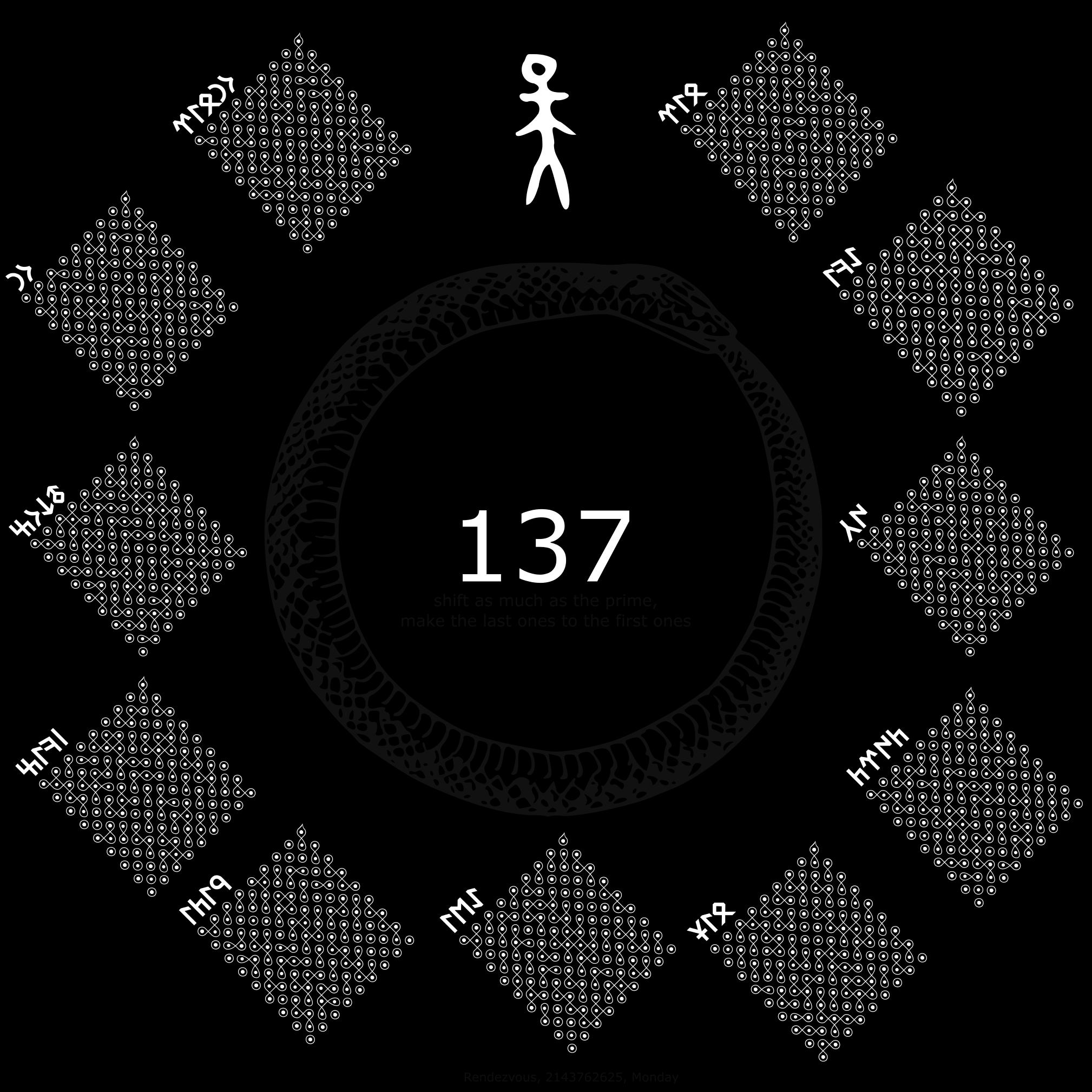
A GOOD detached signature authenticates the November 2017 rendezvous137 image. It is not merely afterlife material: a signed post explicitly opens it as the replacement for the missed first path. Its timestamp resolves to Monday, 7 December 2037, 01:37:05 UTC. Other later images, account activity, a blockchain inscription, Vumarii writing, and documents titled around Uniqmos, a Time Loop Processor, compressed solar light, and a “Modern Politeia” extended the project’s aesthetic and ideology.
These later branches do not all carry the same weight. A signed publication is strong evidence of continuity under the key; a screenshot is evidence of what an account displayed; stylistic similarity is only circumstantial; a community transcript that has not been regenerated from pixels remains provisional.
Rendezvous and Red Triangle
The signed 2017 image is authentic and its eleven labels read as Turkish numbers 1–11. Defango/Cicada/Red Triangle narratives around it include separate speculation; the author issued a signed denial that Defango was Tengri 137.
Kolam material
The raster is now transcribed directly: every 145-dot panel maps to a 16×16 crossing matrix, for 2,816 bits total. The source-led panel order and one-nibble phase yield a 352-character printable English warning. The extraction is solved; the warning’s authorial purpose and the expected 2037 action remain open.
Vumarii
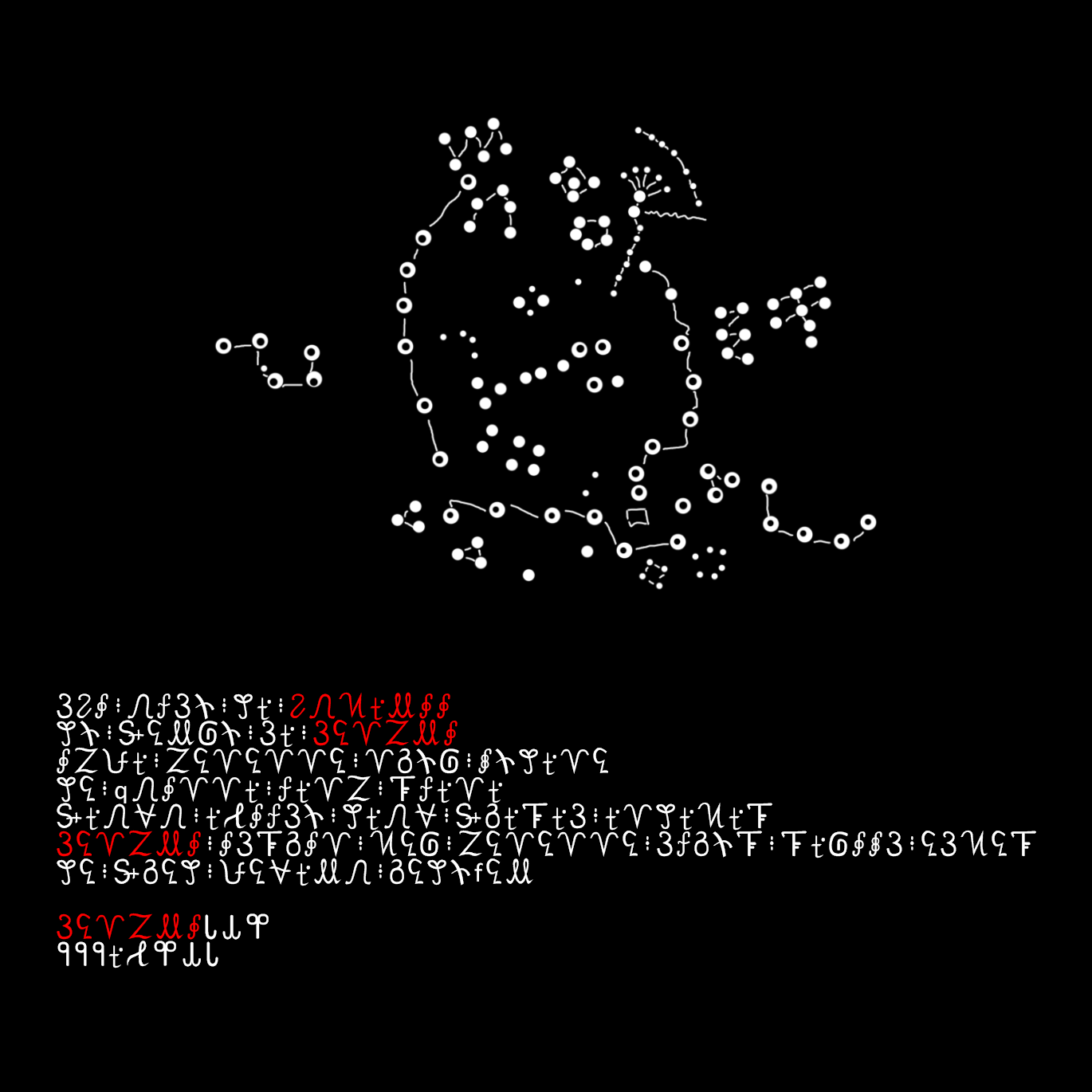
The separate signed 2019 star-map image remains untranslated: its glyph body and any map traversal are still open. A later proposal connecting 2024/25 white-script rasters to a 2019 science article was retracted after its controls and provenance chain failed. It is not treated as a quotation, alphabet, or key here.
Uniqmos, TLP, and Politeia
Later technical and political texts continue the motifs of 137, cosmic structure, radical social redesign, and speculative physics. They document a creative/intellectual continuity, not validated science.
The 2026 selenoprotein theory
An AI-generated repository proposed a protein/genetic solution, but its own files contain self-falsification, wrong-cell patching, and negative biological evidence. Original-source mirrors are useful; the interpretation is speculation.
Attribution
Austria metadata, Turkish linguistic material, linked accounts, and a distinctive document cluster point toward a plausible milieu. No authenticated statement binds the Tengri key to a named legal identity.
Small signals that remain small
The post-2017 timeline also contains an “OMEGA DAY” image, a signed rendezvous image, a hex-to-base64 breadcrumb yielding Bennu, a Baatar Kerei video link, short philosophical replies, a concentrated-sunlight project, TLP posts, “Epochal Multiverse” prose, and Vumarii images. Some are authenticated as posts or files; most do not come with a reproducible puzzle operation. They are preserved as continuity evidence, not promoted into solutions by tone alone.
Source note: post-2017 activity record.
CHAPTER XIII · THE DOCUMENT TRAIL
What the later papers actually claim
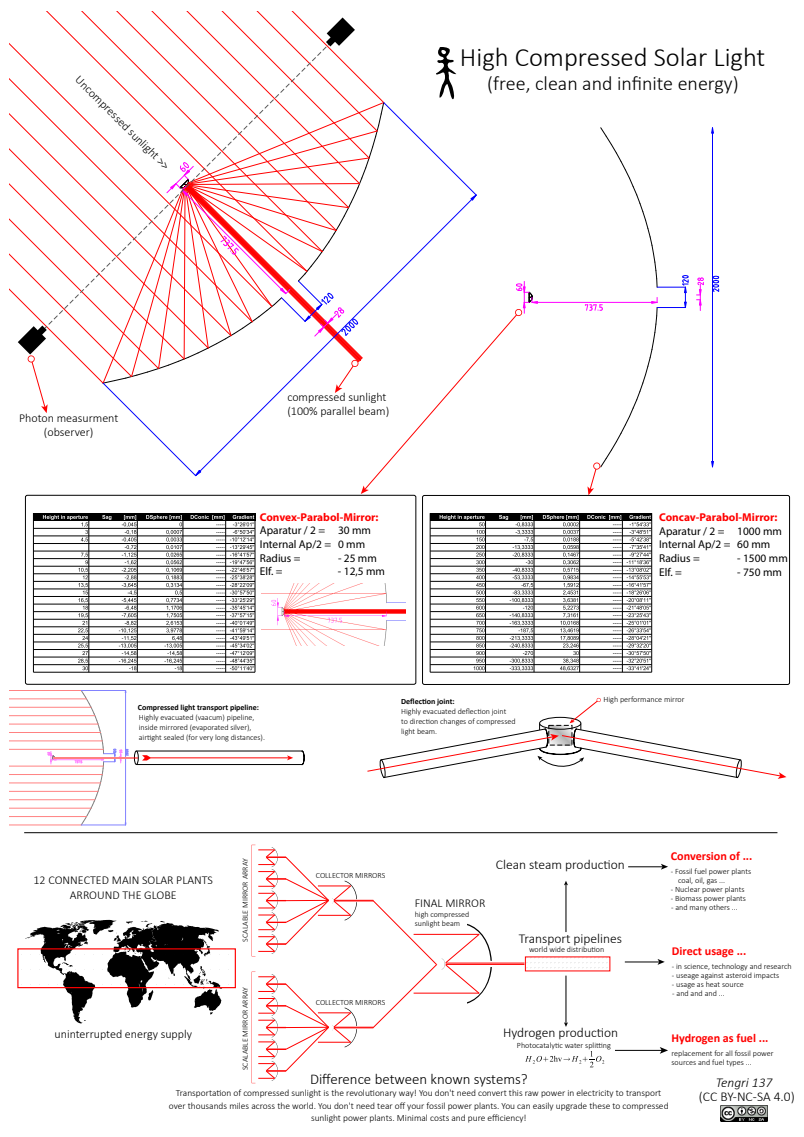
The working repository contains a second body of material: later texts distributed with or associated with the Tengri 137 trail. They are useful evidence of recurring themes, but they are not experimental papers, product documentation, or proof that their technical claims work. Read as documents of a worldview, they are unusually revealing.
Uniqmos
Three texts propose identical multidimensional units in bound and unbound states as the substrate of matter and apparently empty space. They recast gravity, quantum effects, dark energy, black holes, and cosmic evolution through that premise. The papers state possible tests, but the dossier found no empirical demonstration or independent validation.
The replicator paper
A 2025 extension imagines matter replication by mapping and rearranging Uniqmos configurations, including quantum states. Its own account requires measurement and control far beyond known capability. It is a speculative extrapolation contingent on an unverified hypothesis—not a blueprint for a device.
Time Loop Processor
A 2024 German-language concept paper proposes accelerating computation by sending data through closed timelike curves, using Casimir-style negative energy, quantum memory, and optical links. It explicitly acknowledges that macroscopic closed timelike curves and causality control remain unresolved. No functioning processor is evidenced.
Compressed sunlight
The energy material proposes collecting, concentrating, and transporting solar light through evacuated reflective pipelines, with applications from industrial heat to hydrogen production. It is an engineering proposal; the files do not document a prototype, efficiency measurement, safety case, or long-distance demonstration.
Modern Politeia
The political manifesto adapts Aristotle’s mixed constitution to oppose Michels’s “iron law of oligarchy,” favouring accountability, rotation, decentralisation, and civic oversight. This is a normative political argument, not a solved riddle or a source for the cryptographic claims.
The through-line
Across the book and later papers, the recurring appeal is to a hidden underlying order: a privileged decoder, a universal physical substrate, a redesigned energy system, or a redesigned polity. That continuity can support a provenance lead. It cannot, by itself, identify the anonymous author or validate the claims.
Editorial boundary. The dossier preserves these propositions because they explain the project’s language and later development. It does not promote them as established physics, engineering, medicine, or political science.
CHAPTER XIV · THE AUTONOMOUS AUDIT
One day of scraping became a test of the whole legend
The companion corpus was not assembled as a scrapbook. Its governing rule was adversarial: preserve exact bytes, reconstruct from independent channels, record disagreements, rerun computations, and prefer an honest gap to a plausible invention.
The investigation recovered signed artifacts, verified PGP signatures, rebuilt the page-23 arithmetic, measured its linguistic structure, reproduced the Arecibo bitmap, corrected the WAV encoding from octal to base 9, and audited claimed identities. The 2026 passes then proved the bitmap’s digit-to-bit rule, measured the two deliberately symmetric added figures, and reproduced a 4 × 4 Hill decryption of the entire signed themessage.txt.
ClaimAudit result
47 × 137 grid for
themessage.txtREJECTED · impossible lengthMatrix produced by the audio WAVREJECTED · separate source chains
Amino-acid / selenoprotein plaintextREJECTED · composition and tests fail
Author declared one orientation correctREJECTED as an author statement
Turkish acrosticSTRONG INVESTIGATOR-DERIVED CANDIDATE
themessage.txt 4×4 Hill decryptionREPRODUCED · bitmap-derived key, 6,448 lettersThe result is not a magical final key. It is something more useful: a sharply bounded case. We now know which bytes are authentic, which transformations reproduce, which stories entered later, which avenues are dead, and where a genuine discovery could still occur.
EPILOGUE · WHAT TENGRI 137 IS
A crafted mystery about authority, selection, and the desire to believe
Tengri 137 is a real and unusually elaborate anonymous puzzle. Its cryptography, metadata, mathematical constructions, staged audio route, and signed publication trail demonstrate planning and technical competence. They do not demonstrate alien authorship, new physics, genetic selection, mind reformatting, or a supernatural library.
Its most effective trick is psychological. The story tells readers that failure proves they lack the correct biology or knowledge. The evidence-led response is the opposite: every proposed solution must become more specific, more reproducible, and easier to falsify.
SOLVED Book pages 1–22 and the construction of the page-23 matrix.
STRONG CANDIDATE The Turkish acrostic as page 23’s intended natural-language payload.
SOLVED The key and plaintext of the authenticated 6,448-letter message: a bitmap-derived 4×4 Hill decryption.
RECOVERED The first instruction resolves to the ONION archive and signed knowledge.txt; a later signed post documents why that timed path closed.
ACTIVE ENDPOINT The replacement rendezvous route points to Monday, 7 December 2037, 01:37:05 UTC.
DECODED All eleven rune labels, 2,816 kolam bits, and the 352-character warning; OPEN the authorial purpose of the warning and the 2037 appointment.
BLOCKED The original WAV bytes; UNPROVEN real-world authorship.
The case is no longer a pile of mysterious files. It is a chronology of deliberate signals, public breakthroughs, disappearing infrastructure, false trails, and a small number of hard questions that still deserve an answer.